Curriculum
Curriculum
| ## | Core courses | Credits |
| 1 | Business Analytics and Decision Making with AI | 3 |
| 2 | AI Ethics and Governance | 3 |
| 3 | Machine Learning, Deep Learning and LLMs for Business Applications | 3 |
| 4 | Generative AI and Prompt Engineering for Business | 3 |
| 5 | Business Data Management for AI | 3 |
| 6 | Experiential Learning in AI for Business | 3 |
| 7 | Advanced AI and Business Strategy | 3 |
Elective courses (choose one track) | ||
Business-oriented Track (choose any three courses) | ||
| Leadership in the AI era | 3 | |
| Digital Transformation and Innovation Management | 3 | |
| Global Sustainable Investing & ESG Integration in Business | 3 | |
| Marketing Strategy and Analytics | 3 | |
| AI-based Innovation and Entrepreneurship | 3 | |
| Special Topics in AI for Business | 3 | |
Technical-oriented Track (choose any three courses) | ||
| Human-AI Collaboration | 3 | |
| Agentic AI and Applications | 3 | |
| Advanced System Analysis and Design | 3 | |
| Management Support and Business Intelligence Systems | 3 | |
| AI and Natural Language Processing in Business | 3 | |
| AI-enabled Data Visualization | 3 | |
Total Credits | 30 |
Example:
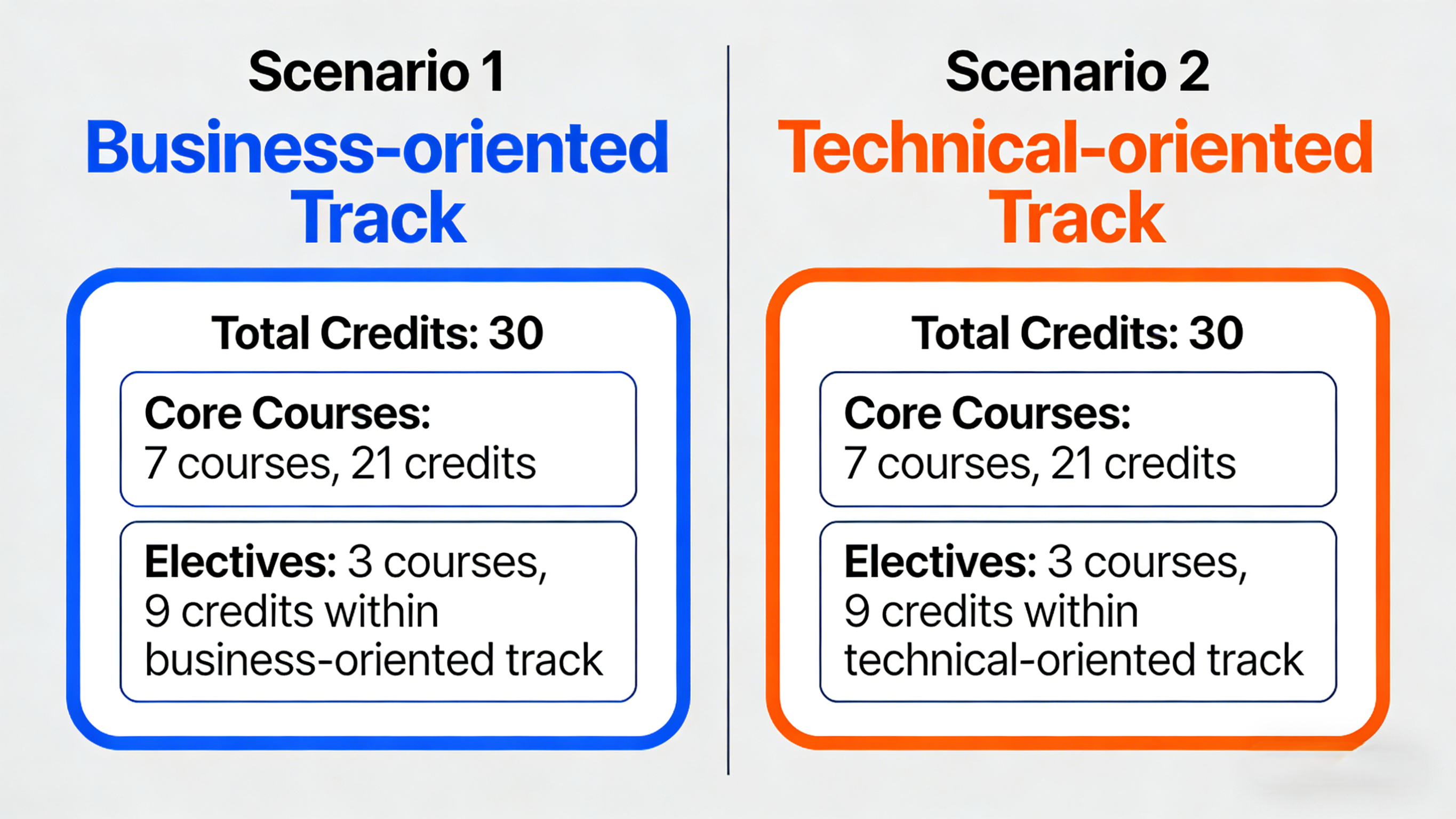
In Scenario 1, If students want to pursue degree with business-oriented track, to fulfil the requirements, students must earn a total of 30 credits, which includes 21 credits from the seven core courses and 9 credits from three electives within the business-oriented track.
In Scenario 2, If students want to pursue degree with technical-oriented track, to fulfil the requirements, students must earn a total of 30 credits, which includes 21 credits from the seven core courses and 9 credits from three electives within the technical-oriented track.